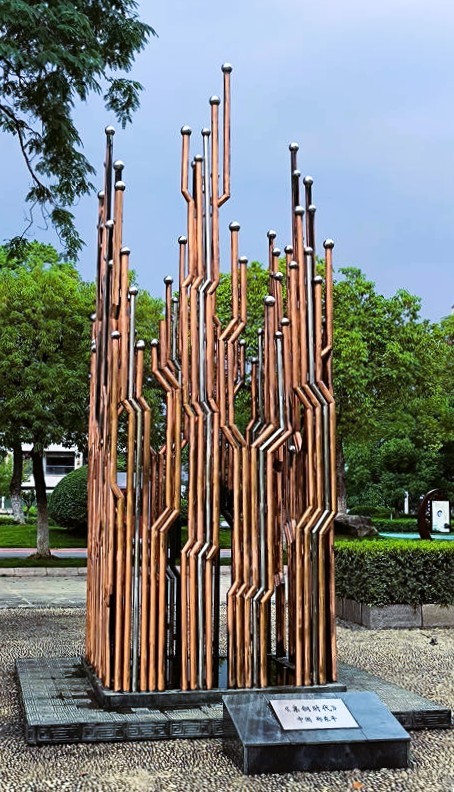
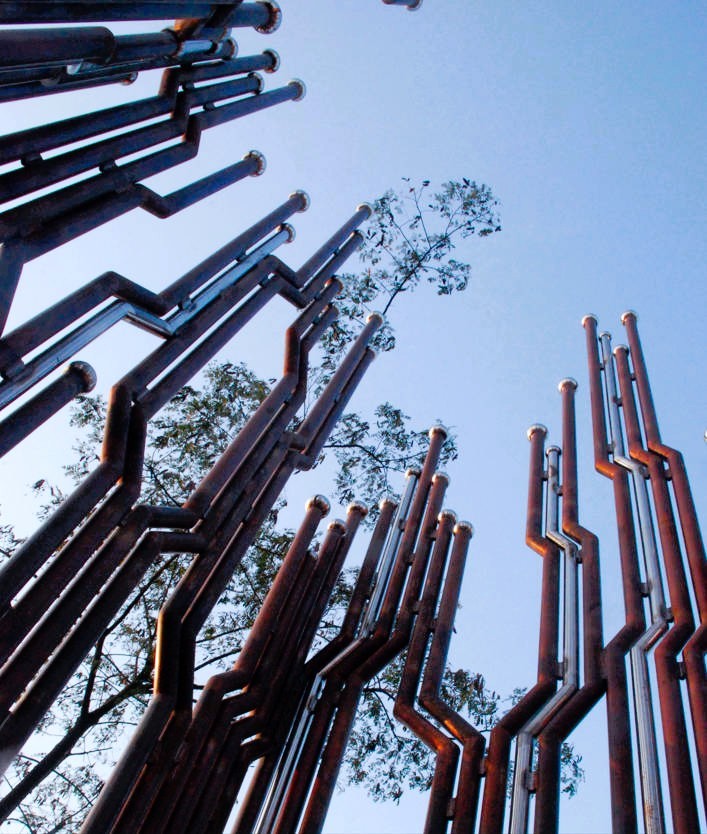
Changing copper forms trace the material’s place in human life, from ancient civilisation to contemporary art.
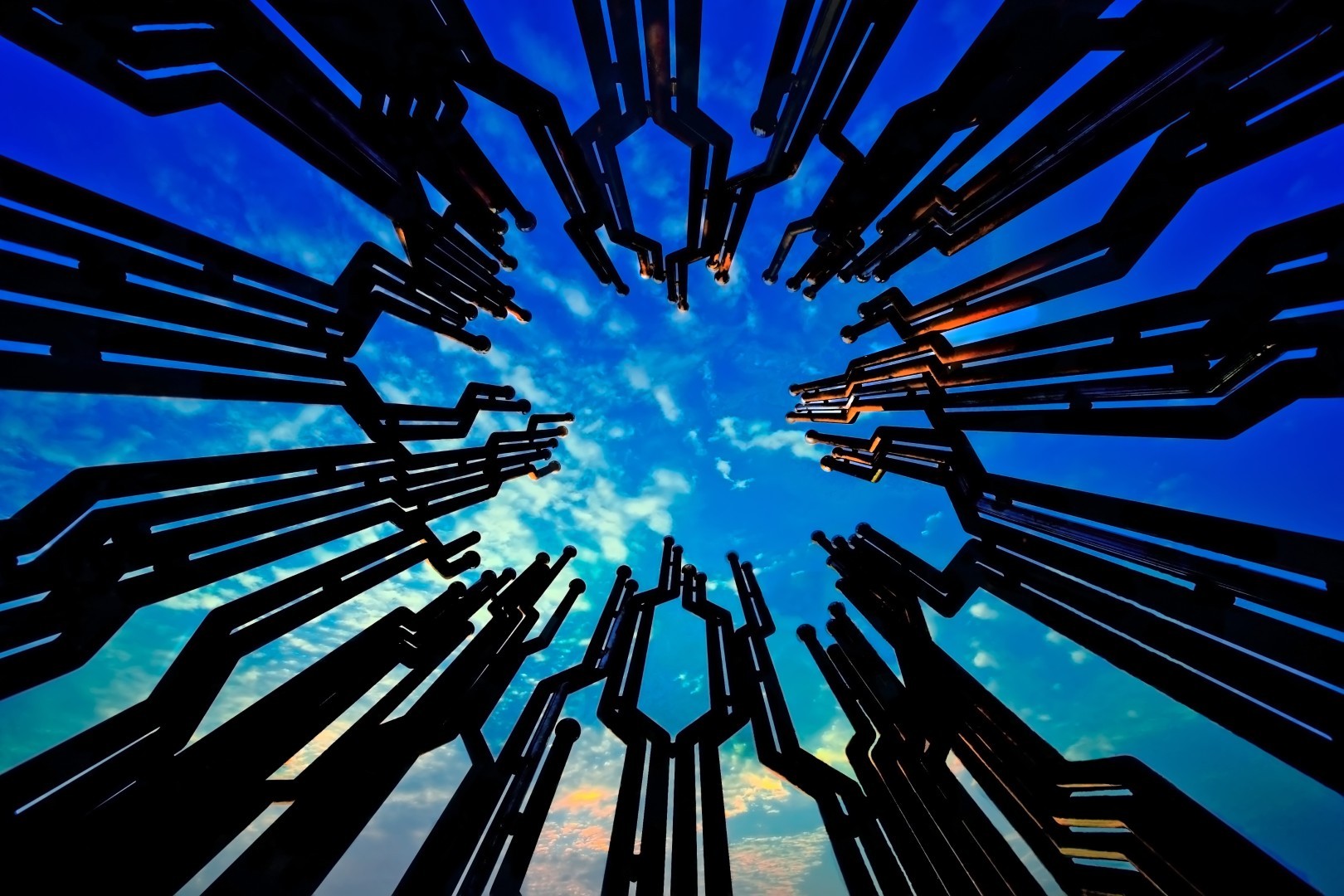
Into the Copper Age explores the changing forms of copper in human life, from antiquity to the present.
The work traces a passage from material to meaning. Copper bears witness to thousands of years of civilisation and remains an essential medium for everyday life and artistic expression.
Moon Shadow-2 brings together the curve of a crescent moon and the rising and falling rhythms of a landscape. Its clear outline evokes the image of mountains and rivers coming into view.
Deep grooves suggest the passage of time, while the mirror-finished surface reflects the surrounding environment and brings it into the work.
Woman with Umbrella expresses a woman's warmth and delicacy. Standing in the rain, she conveys longing through the sculpture's spare, flowing lines.
With few lines and a restrained sculptural language, the work gives form to feminine beauty and a quiet anticipation of happiness.
The Bond between Two Different Cultures expresses the exchange and integration of diverse cultures. Different traditions meet within its interwoven forms, setting a wave-like rhythm in motion.
The sculpture brings together the energy of this encounter and the contribution art can make to cultural exchange.
Get Power Back is inspired by the forces that set particles in motion within a magnetic field. Its expanding forms convey speed, energy and a sense of limitless tension.
This movement gives energy and vitality to the surrounding space, evoking the impulse that drives people forward.
Bull draws on the artist's understanding of prehistoric symbols and the natural world—sources that have long inspired human creativity.
Jo Kley brings ideas from ancient art and cave paintings into a contemporary sculpture, combining strength and imagination in a form that expresses the beauty of art.
Bridge of Winds explores exchanges between human perception and material. Its flowing form holds a moment between stillness and movement, evoking a light, dancing breeze that cannot be seen but can be felt.
The elongated structure expresses movement through volume and form, allowing these elements to shape one another.
Tenth Gate Unlocked is built around two curved forms: one stands on the ground, while the other appears suspended in the air. Numerous bronze tubes connect their sweeping surfaces, creating a layered, interwoven structure.
Its movement, changing rhythm and overlapping forms convey the beauty of transformation, bringing harmony and tranquillity into the same composition.
Aeolos is the god of wind. Its crescent-like figure symbolises freedom and the ancient past. The sculpture gives these ideas a tangible form; its graceful shape and sense of balance offer encouragement.
Wind surrounds us everywhere, and encouragement is everywhere too. Like a crescent moon, the work symbolises time and new life, soon moving towards fullness and maturity.
Trinity brings time and space into a three-dimensional form. Three related human figures connect to create a stable, interdependent structure.
The composition gives sculptural form to the relationship between people and nature, echoing the traditional Chinese idea of harmony between humanity and the natural world.
The Remoteness explores the desire to move beyond a frame. An opening and the forms within it are displaced in relation to one another, creating an interplay between enclosure and release.
Contrasting surface textures and interwoven shapes express both intersection and independence, giving the sculpture a sense of movement beyond its boundaries.
Three Moons transforms the familiar crescent moon into an elegant geometric composition. The repeated forms appear delicately balanced, creating tension while suggesting an unexpected lightness.
Through their arrangement and light-coloured steel surfaces, the work reduces the impression of material weight and opens space between its forms.
Each of us follows a different path through life. These paths cross and meet, then continue independently.
The Way of life gives sculptural form to this interplay, expressing the encounters that connect people while preserving the individuality of their lives.
Eternity suggests a line spiralling through infinite space, giving form to movement without an end.
Its angular, interlocking volumes express strength and direction. Through their arrangement, geometric forms become a sculptural language of continuous motion.
Angles, irregular forms and sharply defined lines are the basic elements of Atrio. Together they create a spiralling body that expresses the fluctuations of human emotion.
The sculpture reflects on modern people's attachment to material things and the emptiness that can accompany it.
Lotus Image imagines a pure lotus emerging from clear water. Its form recalls water rising and droplets falling back to meet the surface.
The sculpture gives lasting shape to that brief encounter, capturing the moment when falling water sends a fresh splash upwards.
Space brings together three elements: art, life and modern art. It explores the play of light and shadow found in contemporary architecture.
Its interlocking forms and three-dimensional construction create visual illusions. As viewpoints change, solid volumes and open spaces contribute to the sculpture as a whole.
A mother guides her child through their first steps. Her patient instruction carries a hope that the child will learn to face difficulties and walk steadily through life.
Learn to walk gives this everyday moment a lasting form, expressing a mother's care and her wishes for the path ahead.
Feng Chongli draws on his experience of Chinese ink painting to explore the meeting of nature and industry, tradition and modernity. Their collision gives rise to the imagery of Bamboo in Wind.
Through this sculptural language, the work reflects on the relationship between nature and humanity, and between the material and the spiritual.
A young Miao girl pauses to rest in the sunshine. Her absorbed expression seems to hold a melody that has not yet come to an end.
The work invites us to share this quiet moment without disturbing her, allowing the unfinished music and the warmth of the sunlight to linger.
Garden gives form to the dreams and hopes that each of us carries within. Its openings extend the viewer's gaze beyond the sculpture and into the world around it.
Care for that outer world, and a harmonious relationship with it, allow our inner garden to bloom. The work connects this idea of an inward garden with the life beyond its boundaries.
Opening and Succession demonstrates the possibilities of bronze casting and reflects the continuing development of Tongling's casting tradition.
The work brings together positive and negative forms created through mould-making, transformations between different materials, and finely developed details. Through these processes, it explores new ways of carrying a craft tradition forward.
Song of Wind Flute evokes a melody of parting and homesickness. Its quiet sadness carries an ancient, flowing grace.
The figure seems to send that music out into the world, calling for loved ones to be reunited and for those who have left their hometown to return.
Time passes and the world changes; all things have a spirit. Whisper personifies chairs, giving them a sense of life and feeling.
From within the group, viewers can experience an imagined conversation between the forms. Seen from a distance, they become a distinctive sculptural scene with a Chinese character.
Take Dreams as Horse places its rider within a landscape suggested by distant mountains and nearby water.
Taking dreams as a horse, the work expresses a search for a quiet, peaceful spiritual home.
Flowing Answers reflects the uncertainty and unpredictability of contemporary life through the image of a cello transformed into flowing liquid.
By giving a solid instrument a fluid form, Yu Chang brings the patterns and texture of an ever-changing world into sculpture.
A young figure wearing a red scarf runs across auspicious clouds, holding a paper airplane and moving towards the future.
Drawing on traditional sculptural modelling, Zhao Yong creates an imaginative scene filled with peace, serenity and hope.
Two hearts are free yet connected, sharing hardship and supporting one another within a world of feeling and ideals.
Through its paired forms, Fly Wing to Wing expresses the pursuit of freedom, the care that protects a relationship, and a celebration of life.
Tsunami draws on an ancient Greek idea in which the soul is air, the body is sustained by water, and air and water surround the world.
The sculpture uses the body as a framework to explore the relationship between body and soul, making the hollow space within the form part of that imagined world.
Bird transforms the familiar structure of a bird through simplified forms that echo and respond to one another.
Curves beneath the tail enclose a hollow space, suggesting the air gathering and moving as the bird prepares to take flight.
Light moving across the metal surface is the central subject of this sculpture.
Reflections change the appearance of the form, giving the work a presence that depends on its surroundings as much as on the material itself.
Zeus and Europe retells a Greek myth through a compact, weighty form.
In the story presented by the artist, Zeus takes the form of a bull and carries Europa across the sea to Europe, where their story of love and family unfolds.
A man and a woman play music together, their figures joined in a shared performance.
Conceived for a park setting, Harmony imagines music bringing visitors a sense of energy, optimism and companionship.
Children and a crescent moon become part of an imagined flight.
Playful changes of scale and form express the freedom of childhood imagination and its ability to move beyond ordinary limits.
Print of Lost Worlds traces the imagined paths of the Earth and other planets as they move around stars in an infinite universe.
Their movements suggest a dance, inviting curiosity about the mysteries of the universe and the worlds still to be explored.
Two hands hold a bowl together, giving a simple form to cooperation and shared resources.
The bowl can receive sunlight or channel water, connecting the idea of mutual support with the elements around it.
An angel-like figure connects ideas of the old and the new.
The sculpture reflects on the cultural foundations inherited from earlier generations and their importance in shaping the world that follows.
A figure holds a yogic headstand, turning a familiar human posture upside down.
Annabella Claudia Hofmann uses this inversion to suggest another way of looking at the world and reconsidering what we take for granted.
Lotus flowers rise from the mud towards the light, expressing hope and the possibility of growth.
Lotus Pond sets the stillness of its sculpted plants against their upward movement, celebrating the vitality and promise of life.
A tree-like form rises like a tower in the forest, carrying energy between sky and ground.
Drawing on Zen ideas within traditional culture, Tower of Babel expresses a sense of harmony between human life and the natural world.
A New Day gives form to a plant's growth beneath the ground, a process that becomes visible when a shoot emerges into the light.
After winter, that emergence signals new life in spring. The work also reflects the idea of renewable resources.
The name AYiGuLi brings together the words for moon and flower.
The sculpture portrays a young woman from Xinjiang, expressing beauty, kindness and simplicity, together with a hope for love and a good life.
Struggle gives form to the spirit of perseverance, a source of strength for individual growth and shared happiness.
The sculpture uses a spare, emphatic figure to express the artist's belief that a simple form can carry great force.